
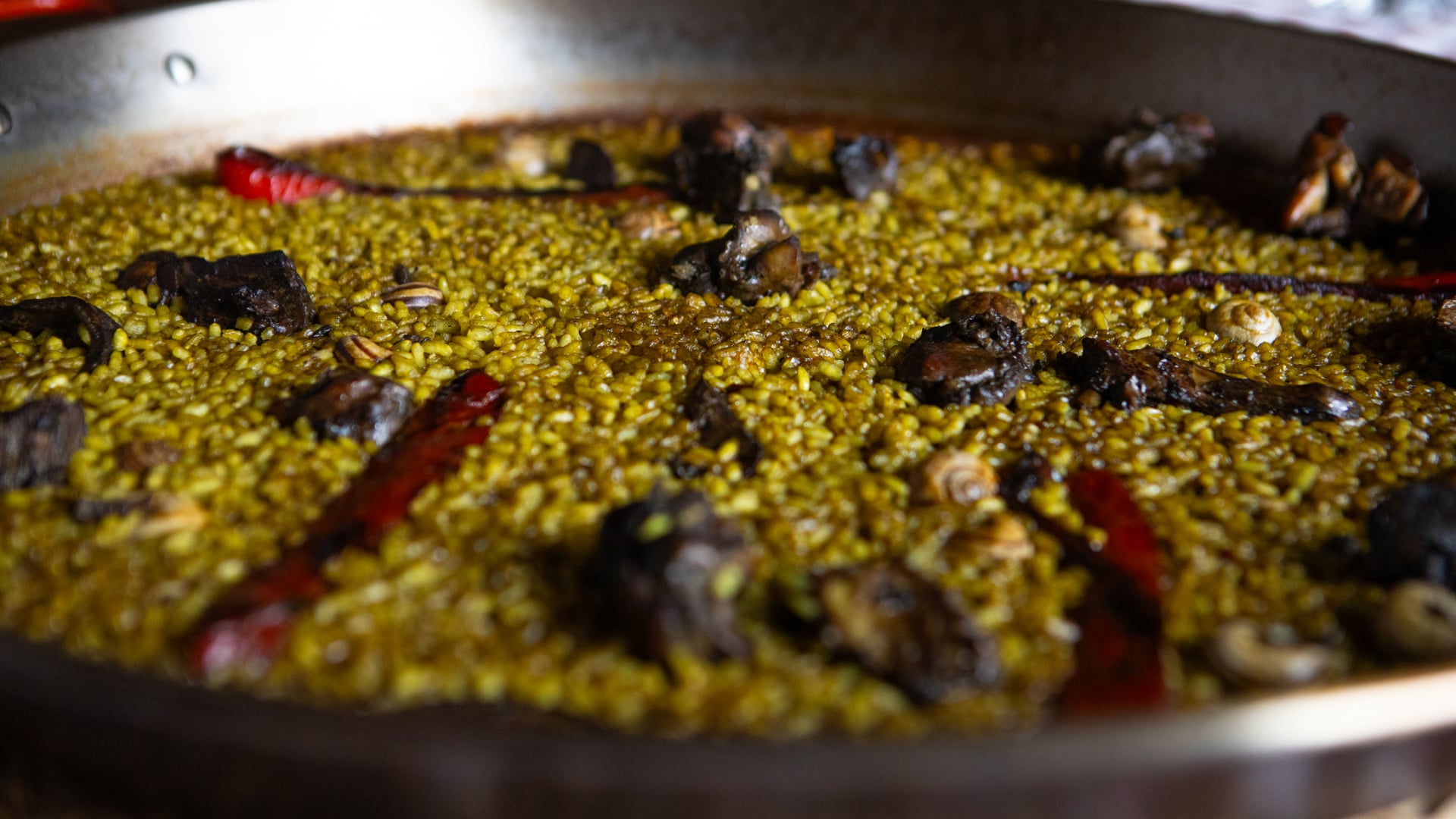
Rabbit and snail rice: the inland Alicante recipe
For many, rabbit and snail rice is the very soul of inland Alicante cuisine. A dish humble in its origins and grand in its flavour, born in the countryside of the Vinalopó and elevated to a jewel of the table. At Finca La Esperanza it is our flagship dish, and in this article we tell you its history, its step-by-step recipe and the secrets that separate a good rice from an unforgettable one.
A dish born in the countryside
Rabbit and snail rice was not born in a restaurant, but in the countryside. It is the logical answer of a make-do cuisine: rabbit, raised or hunted on the land itself; snails, gathered on the banks after the rains; rice, the reliable pantry staple; and the wood fire, always at hand. With these elements, the families of the Vinalopó Valley built one of the great dishes of inland Alicante gastronomy.
Unlike the rices of the coast, where the sea rules, this is a dryland rice. It needs no shellfish or fish: its depth comes from well-browned rabbit, from patient sofrito, from the snails and from the mountain herbs that grow in the sierra. It is mountain cooking in its purest state, hearty and honest.
In time, what was food for day labourers and days in the countryside became the dish of celebrations. Today, ordering a rabbit and snail rice in Petrer is to lay claim to a culinary identity of one's own, that of inland Alicante, which deserves as much recognition as the seafaring rices.
It is worth remembering that rice was not always the humble, everyday ingredient it is today. For a long time it was a product reserved for special days, and that is why the Sunday or festival rice had a special, almost ritual character. Gathering the family around a paella, with the fire lit and the aroma of the sofrito filling the house, was —and still is— a way of celebrating being together. Rabbit and snail rice inherits all of that emotional weight.
The produce: rabbit, snails and stock
No rice is better than its raw ingredients. In this dish, three elements make the difference.
The rabbit
The rabbit must be of good quality, cut into small pieces so that it browns well and releases all its flavour. The initial browning is essential: the meat has to be toasted on the outside, almost caramelised, because that is where much of the rice's final flavour concentrates.
The snails
The snails bring an earthy note and an unmistakable aroma. Traditionally the small local varieties are used, well purged and washed before cooking. Their presence is discreet but defining: a rabbit rice without snails is a different dish altogether.
The stock
The stock is the heart of the rice. It is prepared with the carcasses and trimmings of the rabbit itself, vegetables and aromatic herbs, cooked slowly until you obtain a tasty base. A good stock is, in itself, a complete dish; everything else is built on top of it.
The rice and the oil
The rice variety is also decisive. In the region, cooks traditionally work with bomba rice, capable of absorbing a lot of stock without going soft or breaking, which makes it ideal for a dry rice of concentrated flavour. It is a demanding grain, one that asks for more stock and more attention, but it rewards you with a firm, unmistakable texture. Local olive oil, for its part, is the fat that binds the whole dish together: it lends aroma to the browning rabbit, body to the sofrito and that Mediterranean base that defines the cuisine of inland Alicante.
A rabbit and snail rice is judged by its stock. If the base is well made, the grain only has to absorb it and shine.
The sofrito: where the flavour begins
The sofrito is the foundation on which the dish is raised. After browning the rabbit, it is removed and in the same oil you fry grated tomato, patiently, until it loses its water and concentrates, darkening and turning almost into a paste. This process can take a fair while, and it tolerates no haste: a short sofrito leaves a flat rice; a well-made one, a rice with depth.
It is also the moment for the paprika, which is added away from the fiercest heat so it does not burn and turn bitter, and for the herbs that will give the characteristic mountain touch. Some households add a mash of garlic, ñoras and saffron that rounds off the whole. Every family keeps its own version, and therein lies part of the magic of this dish.
The sofrito is also where the personality of the rice is decided. Some prefer it darker and more concentrated, almost sweet from the long cooking of the tomato; some add a pinch of fresh rosemary gathered in the sierra; and some guard the secret of their mash like a family treasure. These small variations explain why two rabbit and snail rices, made with the same ingredients, never taste exactly the same. In that diversity lies the richness of traditional cooking.
The recipe step by step
This is the traditional sequence for a rabbit and snail rice cooked in a paella pan. Quantities and times depend on the fire and the number of diners, but the order is always the same.
- Brown the rabbit: in the paella pan with good olive oil, brown the pieces of rabbit until they are toasted on all sides. Remove and set aside.
- The sofrito: in the same oil, fry the grated tomato over medium heat until it concentrates. Add the paprika away from the strong heat so it does not burn.
- Add snails and rabbit: return the rabbit to the pan along with the purged snails, and sauté everything for a few minutes with the sofrito.
- The stock: add the hot stock and bring to the boil. This is the moment to adjust the salt and, if using, to add the saffron mash.
- The rice: spread the rice evenly. From here on, it is not stirred. Cook over a high flame for the first few minutes and then lower it so the grain finishes absorbing.
- The rest: when the stock has disappeared and you notice the aroma of the socarrat, remove from the heat and let it rest for a few minutes before serving.
The golden rule: once the rice is spread out, it is not touched. Stirring a dry rice compacts it and ruins the loose texture we are after.
Another key point is the ratio of rice to stock. With bomba rice, the traditional rule speaks of roughly three times as much stock as rice, though the exact figure depends on the fire, the pan and the cooking itself. That is why the most experienced cooks do not measure with cups alone: they watch, listen and correct as they go. It is better to slightly overshoot with the stock and let it evaporate than to fall short and have to add water, which dilutes the flavour. Practice is, with this dish, the best teacher.
The secret of the socarrat
The socarrat is the layer of toasted rice that forms at the bottom of the pan at the end of cooking. For many it is the best part of the dish: crisp, concentrated, with that caramelised note that crowns a good dry rice. Getting it right is a matter of fire and of ear.
How to achieve it
- Heat at the end: when the stock has almost disappeared, raise the flame for a moment to toast the base.
- The ear: the rice "talks". When it begins to crackle softly, the socarrat is forming.
- The nose: as soon as you notice a toasted —not burnt— aroma, remove it from the heat immediately.
The line between a perfect socarrat and burnt rice is razor-thin. That is why the last few minutes demand maximum attention: a golden socarrat is glory; a black one, bitterness. This is where the cook's hand shows.
The socarrat is also a question of the pan and the distribution of heat. The paella pan, wide and shallow-based, is designed precisely so that the rice stays in a thin layer and the heat reaches the whole surface evenly. That is why the size of the pan must match the amount of rice: if the grain piles up, there will be no even socarrat, and if the fire does not cover the base well, some areas will toast and others will not. Mastering these details is what distinguishes someone who cooks rice now and then from someone who does it with true craft.
Common mistakes to avoid
Even with good produce, a rice can fail over details. These are the most common slips.
- Under-browned rabbit: if the meat is not toasted well, the rice loses depth.
- A rushed sofrito: a poorly reduced tomato leaves the dish watery and without a base.
- Cold or scant stock: adding cold stock stops the cooking; falling short forces you to add water and dulls the flavour.
- Stirring the rice: it compacts the grain and ruins the loose texture.
- Serving late: a dry rice overcooks on its own if it waits too long. From the fire to the table, without delay.
If you would like to delve deeper into the rice culture of the region, in our article on the Alicante rices of the Vinalopó we cover all the varieties, from country paella to baked rice.
How to serve it and what to pair it with
Rabbit and snail rice is served in the paella pan itself, so it keeps its temperature and shows off the socarrat. It is traditionally accompanied by good bread for mopping up and, to drink, by a local Monastrell red: its body and spiced notes match the heartiness of the dish to perfection. That pairing is no accident: the same land that gives the rabbit, the snails and the sofrito herbs also produces the wine grape, so plate and glass share an origin and speak the same language.
As starters, the classics of the Alicante table work wonderfully: local olives, coca a la pala with pepper and anchovy, homemade ensaladilla or some mushrooms. And to finish, nothing like seasonal fruit, some homemade sweets and a local liqueur. It is the complete menu of inland Alicante.
There is also a ritual in the way it is eaten. Rabbit and snail rice is enjoyed slowly, in good company and without a clock, letting the after-lunch conversation stretch out as long as it needs to. It is not a dish to eat in a hurry: it asks for time, conversation and that touch of celebration it has always had. Eating it among olive trees, with the sierra in the background, rounds off an experience that goes far beyond the purely gastronomic and connects with the way of life of inland Alicante.
Our flagship rice at La Esperanza
At Finca La Esperanza, rabbit and snail rice is much more than a dish on the menu: it is our hallmark. We cook it as the tradition of the Vinalopó dictates, with homemade stock prepared every morning, patient sofrito, well-browned rabbit and just the right point of socarrat. Each rice is made to order, with the time this dish deserves and that admits no shortcuts.
You can discover this and the rest of our rices —cuttlefish and prawn, and vegetable and lean pork— on the menu. They all share the same philosophy: regional produce, respected fire and unhurried cooking, served among olive trees and with the Sierra del Maigmó in the background.
If you want to try our flagship dish at its best, book your table on 650 45 01 09. Remember that we only open by prior reservation, Wednesday to Sunday. Write to us too from the contact page and we will keep a place for you: the rabbit and snail rice is waiting for you.