
The best rice dishes of Alicante: recipes from the land of the Vinalopó
When people talk about rice dishes in the Valencian Community, the coast grabs all the attention. But inland Alicante —and in particular the Vinalopó Valley— has its own rice culture, more rustic, more hearty and with a character only mountain cooking can give. In Petrer, rice is not a dish: it is an institution.
Rice in the Vinalopó: from the garden to the table
Unlike the coastal rice dishes, where seafood and fish take the lead, the rice dishes of the Vinalopó are born of the countryside. Free-range chicken and rabbit, market-garden vegetables, dried pulses, artisan sausage and the aromatic herbs that grow on the mountains make up a rice repertoire that needs no sea to be extraordinary.
The broth is the foundation of everything. In the homes of Petrer, the broth is prepared from early morning with pork bones, old hen and whatever vegetables are in the larder. A good Vinalopó rice rests on a broth that is already, on its own, a complete dish.
The rice variety also matters. In the region, bomba rice is traditionally used, able to absorb twice as much broth as other varieties without overcooking or breaking. It is a demanding rice —it requires more broth, more time and more attention— but it rewards you with a firm texture and a flavour that concentrates everything it has absorbed during cooking.
The sofrito technique: where it all begins
No Vinalopó rice starts without a good sofrito. It is the aromatic base that defines the character of the dish, and in this region it has its own rules.
The sofrito ingredients
- Extra virgin olive oil from the area: arbequina or blanqueta, fruity and with a peppery edge.
- Grated ripe tomato: never blended or from a tin. The tomato is grated on the coarse side of the grater so it releases the pulp and retains the skin.
- Paprika: a teaspoon at the end of the sofrito, stirred quickly so it does not burn. It is responsible for the colour and the depth of flavour.
- Ñora: in some rice dishes, the hydrated and scraped ñora adds concentrated sweetness and deep colour.
- Garlic: whole or sliced, depending on the recipe. In the country rice it is fried whole; in the soupy rice, sliced.
The point of the sofrito
The sofrito is ready when the tomato has lost all its water and the oil begins to separate from the concentrated tomato. At that moment, the bottom of the paella has a dark, caramelised layer that is pure flavour. Burning this step or cutting it short is the difference between a rice with character and a bland one. The cooks of the Vinalopó know this, and that is why they are never in a hurry.
In the Vinalopó there is a saying: "The rice makes itself; the sofrito does not." Everything that happens to the rice afterwards depends on these first minutes over the fire.
Paella de campo: the queen of Sundays
The paella de campo (country paella) is, without question, the most representative dish of the region. Chopped chicken, rabbit, bajoqueta (green beans), garrofó (butter beans), grated tomato, paprika, saffron, rosemary and a good local olive oil. Cooking over firewood —a tradition still kept in many homes and restaurants— adds a smoky nuance impossible to achieve on a gas hob.
In Petrer, the Sunday paella is non-negotiable. Every family has its version and every cook defends their own. But all agree on the essentials: good produce, a lively fire, and the exact point of the socarrat —that toasted layer at the bottom of the pan that is the hallmark of a well-made rice.
The keys to a good paella de campo
- The fire: lively at first to seal the meat, gentle at the end so the rice cooks evenly.
- The broth: always boiling when added to the rice. Cold broth halts the cooking.
- The proportion: for each measure of rice, two and a half of broth. With bomba rice, three.
- The rest: five minutes covered with newspaper or a clean cloth. The rice finishes absorbing and the flavours settle.
- The sprig of rosemary: added to the broth as it boils and removed before adding the rice. It leaves a mountain scent that defines Vinalopó rice.
Baked rice: the winter dish
If the paella is the rice of spring Sundays, the arroz al horno (baked rice) is its winter equivalent. It is prepared in an earthenware dish, with chickpeas, onion black pudding, pork rib, thinly cut potato and a concentrated broth that reduces in the oven until the surface is golden and crisp.
It is a dish that demands patience: the oven must be hot, the dish warm and the rice well spread so the heat reaches evenly. The result is a dry, intense rice, with that upper crust that crackles when you break it with the spoon. On cold days, nothing beats it.
The black pudding and the potato
The onion black pudding of the Vinalopó is a mild, sweetish sausage that partly melts in the oven and infuses the rice with its fat and flavour. The potato, cut into thin slices, is placed on the surface so it browns with the oven's direct heat. When you take it out, it has the texture of a confit potato on top and is soaked in broth underneath.
Arroz con costra: the Alicante jewel
The arroz con costra (crusted rice) is perhaps the most singular recipe in the Alicante repertoire. The rice is cooked with a sausage broth —longaniza, blanquet, black pudding— and, when almost ready, is covered with beaten egg and gratinated in the oven until it forms a golden crust that seals all the aromas inside.
It is a festive dish, for celebrations. In Petrer and the surrounding area it is made at Christmas, at christenings and on any occasion that deserves a rice with more personality than average. Finding it outside the province is difficult; eating it in its own territory is an experience you do not forget.
The egg technique is the detail that makes the difference. The egg must be beaten just before pouring it, the layer must be thin and even, and the oven must be at full power so the crust sets quickly without drying out the rice beneath. When done well, breaking the crust with the spoon releases an aromatic steam that sums up everything good about the traditional cuisine of the Vinalopó.
Soupy mountain rice
For those who prefer the spoon to the fork, the arroz caldoso de montaña (soupy mountain rice) is the Vinalopó's answer. Rabbit, seasonal mushrooms, artichokes or tender broad beans according to the season, and a long broth that soaks the rice without drying it completely. It is served in an earthenware dish, steaming, with a drizzle of raw oil that perfumes every spoonful.
It is a comforting rice, of the kind you eat slowly and remember for a long time. The key is in the balance between broth and grain: there must be enough liquid for each spoonful to be juicy, but not so much that it becomes soup. It is a subtle point that requires experience and attention to the fire.
The mountain mushrooms
In autumn, the mountains surrounding Petrer —Maigmó, Silla del Cid, Xorret de Catí— produce saffron milk caps and other wild mushrooms that are the perfect complement to the soupy rice. Local foragers gather them early in the morning and sell them in the area's markets. Their meaty texture and earthy flavour add a dimension no cultivated mushroom can match.
Rabbit and snail rice
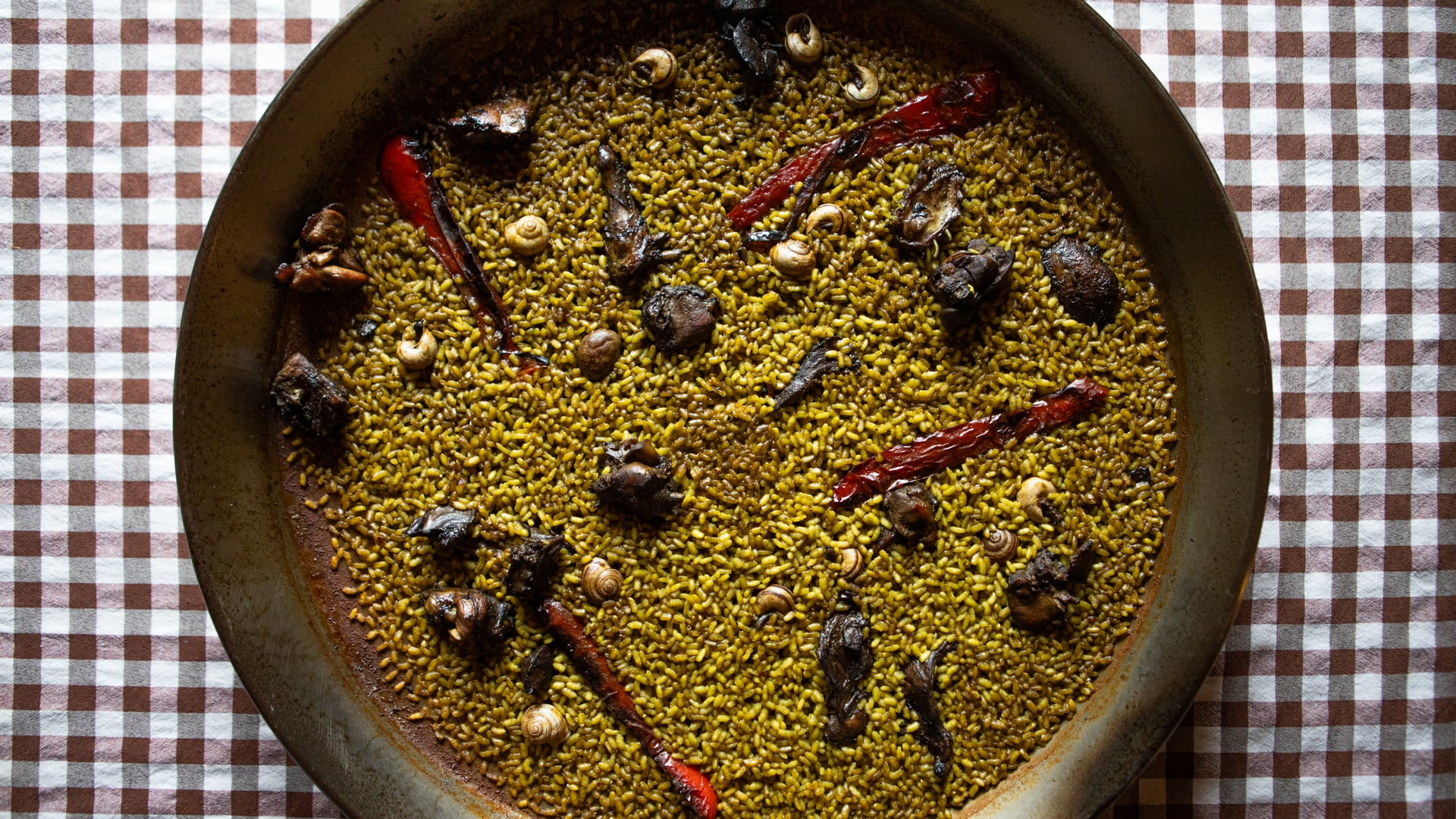
If there is one rice that defines inland Alicante, it is the rabbit and snail rice. It is a country dish in its purest form: chopped rabbit, mountain snails purged for days, rosemary, thyme and a powerful sofrito of tomato, garlic and paprika.
The snails contribute a mineral, earthy flavour unlike anything else. They are eaten straight from the shell, sucked out with the skill that comes from years of practice. For the uninitiated it may seem intimidating, but one taste is enough to understand why this rice has unconditional devotees throughout the region.
At Finca La Esperanza, the rabbit and snail rice is served for a minimum of two people, because it is a dish for sharing. The paella is placed in the centre of the table and each diner eats directly from it, respecting their own sector —as tradition dictates.
Fideuà of the Vinalopó
Although fideuà is usually associated with the coast —its origin is in Gandía— the Vinalopó has its own inland version. Instead of seafood, the Vinalopó fideuà is made with rabbit, rib, market-garden vegetables and a concentrated meat broth.
The fine noodle is lightly toasted in oil before adding the broth, which gives it a toasted-nut flavour that is a house signature. The cooking is shorter than that of rice, and the result is a dish with a completely different texture: crisper on top, softer inside, with a pasta socarrat that crunches when you bite it.
It is not a dish found on every menu, but those who know it always order it. It is the perfect alternative for days when the body asks for something different from rice without leaving the region's culinary vocabulary.
How to judge a good rice as a diner
You do not have to be a cook to know whether a rice is well made. There are signs any diner can read.
What to look for
- The loose grain: each grain should separate from its neighbour. A stodgy rice indicates too much broth or too little fire.
- The socarrat: the toasted layer at the bottom. If the paella has no socarrat, it did not have enough fire at the end. If the socarrat is burnt (black, bitter), it has gone too far.
- The flavour of the broth: the rice should taste of its broth, not of water with colouring. If you bite a grain and it tastes of something, the rice is well made.
- The texture: firm on the outside, tender on the inside. Neither raw nor overcooked. In bomba rice, this point shows especially well.
- The colour: even, without white patches (areas without broth) or dark patches (burnt). The colour should be uniform across the whole surface.
What to avoid
- Rice served in a deep plate instead of in the paella pan or dish itself: it loses temperature and presentation.
- Rice that reaches the table more than five minutes after coming off the fire: it overcooks on its own.
- Rice with ingredients that are not in season: if you see artichokes in August, something is wrong.
The rice dishes at Finca La Esperanza
At Finca La Esperanza, rice holds the place it deserves on the menu. We work with bomba rice, homemade broth prepared every morning and seasonal produce from the region. Each rice is cooked to order, with the time and attention a dish that allows no shortcuts requires.
Our rice menu includes three fixed varieties —the rabbit and snail rice, the cuttlefish and prawn rice and the vegetable and lean pork rice— which cover the whole spectrum of Vinalopó rice cookery: countryside, sea, and inland and market garden.
If you want to try the rice dishes of the Vinalopó at their best, we await you with the paella ready. Book your table and let the rice speak for itself.