
Vinalopó olive oil: the olive trees around the finca
The olive oil of the Vinalopó cannot be understood without looking at the landscape that produces it. Just step out onto the terrace of Finca La Esperanza to see dozens of centuries-old olive trees spreading up the hillside, their trunks twisted by time and their canopies a silvery green that shifts with the light of the day. Those trees are not scenery: they are the origin of a culture that has fed the families of Petrer and the whole Vinalopó Valley for centuries.
A landscape made of olive trees
Anyone driving to the Partida Caprala in Petrer crosses a sea of olive trees before reaching the finca. These are trees that have been here for generations, many of them planted by great-grandfathers whose names no one remembers any more. Much of the agricultural history of this region has been written among their roots, a history in which the olive, the vine and the almond have for centuries been the livelihood of a land of dry farming and mountains.
The Alicante olive tree is a tree of astonishing resilience. It survives summers of over forty degrees, winters with frosts and entire years with barely any rain. That toughness, far from harming the fruit, concentrates it: the olives of the Vinalopó are small but intense, and from them comes an oil with character, with balanced bitterness and pungency, that speaks of the arid climate and the limestone soil in which it grows.
Surrounded by the Sierra del Maigmó, the finca enjoys an ideal microclimate for the olive grove. The cool nights of the mountains and the sunny days of the valley create a temperature contrast that favours the slow ripening of the olive. The result is an oil that, when tasted freshly milled, conveys the exact flavour of this corner of Alicante.
The olive tree in the history of the Vinalopó
The cultivation of the olive in these lands is nothing new. The Romans already pressed olives in the region, and from that era there remain traces of oil mills and stone counterweights scattered across the valley. With the later Andalusi presence, olive culture was refined: irrigation systems were improved, varieties were selected and oil became a product of trade and not merely of subsistence.
For centuries, every family in Petrer with a plot of land had its olive trees. The olive harvest, in the middle of winter, was a collective task in which neighbours, relatives and day labourers took part. Blankets were spread beneath the trees, the branches were beaten with long canes and baskets were filled that were then carried to the village mill. That oil, stored in clay jars, had to last the whole year: for cooking, for preserving cured meats, for healing wounds and even for lighting oil lamps.
In the Vinalopó, oil was never a luxury: it was the pantry, the medicine and the light of the home. A litre of oil was a litre of security against the winter.
That intimate relationship between the olive tree and everyday life explains why oil holds such a central place in the culinary tradition of Petrer. It is not just another ingredient: it is the thread that links the landscape to the plate. If you are interested in how those customs live on at today's table, we recommend our article on the gastronomic heritage of the Vinalopó.
How the oil is born: from tree to mill
Making a good extra virgin olive oil is a process that begins long before the harvest. The winter pruning, the care of the soil and the exact moment of picking determine the final quality. In the Vinalopó region, the traditional harvest is concentrated between November and January, when the olive is at its optimum point of ripeness: neither too green nor too ripe.
The harvest
Table olives are picked by hand so as not to damage them, while those destined for milling can be harvested by beating or with mechanical vibrators. What matters is that the fruit arrives sound and clean at the mill in less than twenty-four hours: the less time that passes between the tree and the milling, the better the oil.
Cold milling
At the mill, the olives are washed, crushed with the stone included and beaten at a controlled temperature. Cold extraction, below 27 degrees, is what preserves the aromas, the polyphenols and the flavour. From that paste the oil is separated from the water and the pomace by centrifugation, and what comes out is a pure olive juice, unrefined, that keeps all its character.
The first oil of the year
There is a magical moment in the olive grove's calendar: that of the first oil of the season, the so-called new oil. It is an intense green oil, cloudy, with a herbaceous aroma and a pronounced pungency at the back of the throat. In many Vinalopó households it is celebrated with a simple slice of toasted bread with freshly milled oil, perhaps with a little salt and a rubbed clove of garlic. Few gastronomic pleasures are so honest.
Varieties and flavour of Alicante oil
Alicante oil has a personality of its own thanks to its native varieties, adapted to dry farming and to the continentalised Mediterranean climate of the interior. Each one lends different nuances to the final oil.
- Blanqueta: the province's most emblematic variety. It yields smooth, sweet, fruity oils, with slight touches of apple and almond. It is the base of many of the region's oils.
- Villalonga: it brings intense fruitiness and an elegant bitterness, much prized in blends with the blanqueta.
- Alfafara and Changlot Real: minority varieties that add complexity, with green notes of grass and tomato-plant leaf.
The combination of these varieties makes it possible to obtain versatile oils, capable of dressing a rice dish, seasoning a salad or finishing a dessert. A good extra virgin olive oil from the Vinalopó does not mask the flavour of the food: it enhances it, unites it and gives it depth.
A well-made oil is not noticed, it is missed. It is in the sofrito, in the bread, in the salad, and yet it goes unnoticed until it is gone.
The oil in the kitchen of the house
At Finca La Esperanza, olive oil is the invisible ingredient that underpins the whole menu. It appears in every preparation, from the sofrito that gives depth to our rice dishes to the drizzle that crowns a toast or a salad. To cook Mediterranean cuisine without good oil is like painting without light: technically possible, but soulless.
The sofrito, foundation of the rice
Our rice dishes —the rabbit and snail rice, the flagship of the house, or the cuttlefish and prawn rice— always begin with a good splash of oil in which the meat, the tomato and the ñora pepper are browned. That sofrito, made over a low heat, is what decides the final flavour of the dish. Without a quality oil, no rice is worth its salt.
The coca a la pala
The coca a la pala with pepper and anchovy is brushed with oil before and after baking. The oil is what gives the dough that crisp, golden touch, and what integrates the sweetness of the roasted pepper with the salt of the anchovy. It is a perfect example of how a humble ingredient, well treated, becomes the star.
Raw oil, the best finish
There are dishes in which the oil is served raw, uncooked, so that it releases all its aroma: some dressed olives, a salad of garden tomato, some grilled mushrooms. In those cases, the quality of the oil is everything. That is why we work with local oil, milled close to where the olive trees that surround the finca grow.
Health, culture and the Mediterranean diet
Extra virgin olive oil is the pillar of the Mediterranean diet, recognised by UNESCO as an Intangible Cultural Heritage of Humanity. Rich in oleic acid and in natural antioxidants such as polyphenols and vitamin E, it is an ally of the heart and an example of how pleasure and health can go hand in hand.
But beyond its nutritional properties, oil is culture. It is the shared table, the dipped bread, the conversation that stretches on. In the Vinalopó, offering good oil to those who visit is a form of hospitality, a gesture of generosity that says a great deal about the way of understanding life in this land.
The olive grove, moreover, fulfils an essential ecological function. It holds the soil in place in a land of hillsides, prevents erosion, offers shelter to wildlife and shapes a landscape that is part of the identity of Petrer. To care for the olive tree is to care for the land, and to care for the land is to care for the pantry.
How to recognise a good oil
Not all oils are the same, and learning to tell them apart is part of olive-grove culture. A quality extra virgin olive oil is recognised by its clean, fruity aroma, reminiscent of fresh olive, freshly cut grass or green leaf. On the palate it should present a balance between sweetness, bitterness and that characteristic pungency felt at the back of the throat which, far from being a defect, is a sign that the oil retains its antioxidants intact.
It should be kept away from light and heat, in a cool place and in an opaque container, because oil oxidises easily. And it should be consumed relatively soon: unlike wine, oil does not improve with the years, but loses freshness. The best oil is always that of the latest harvest, and that is one of the advantages of living in a land of olive trees: here the oil never travels far nor waits too long.
A product with a future
Against mass industrial production, the oil from the small mills of the Vinalopó represents a commitment to quality, traceability and respect for the landscape. More and more consumers are seeking oils with a name and an origin, made with care and tied to a specific territory. In that context, the centuries-old Alicante olive grove has much to say: it is history, it is flavour and it is a way of keeping the countryside alive.
The olive trees of Finca La Esperanza
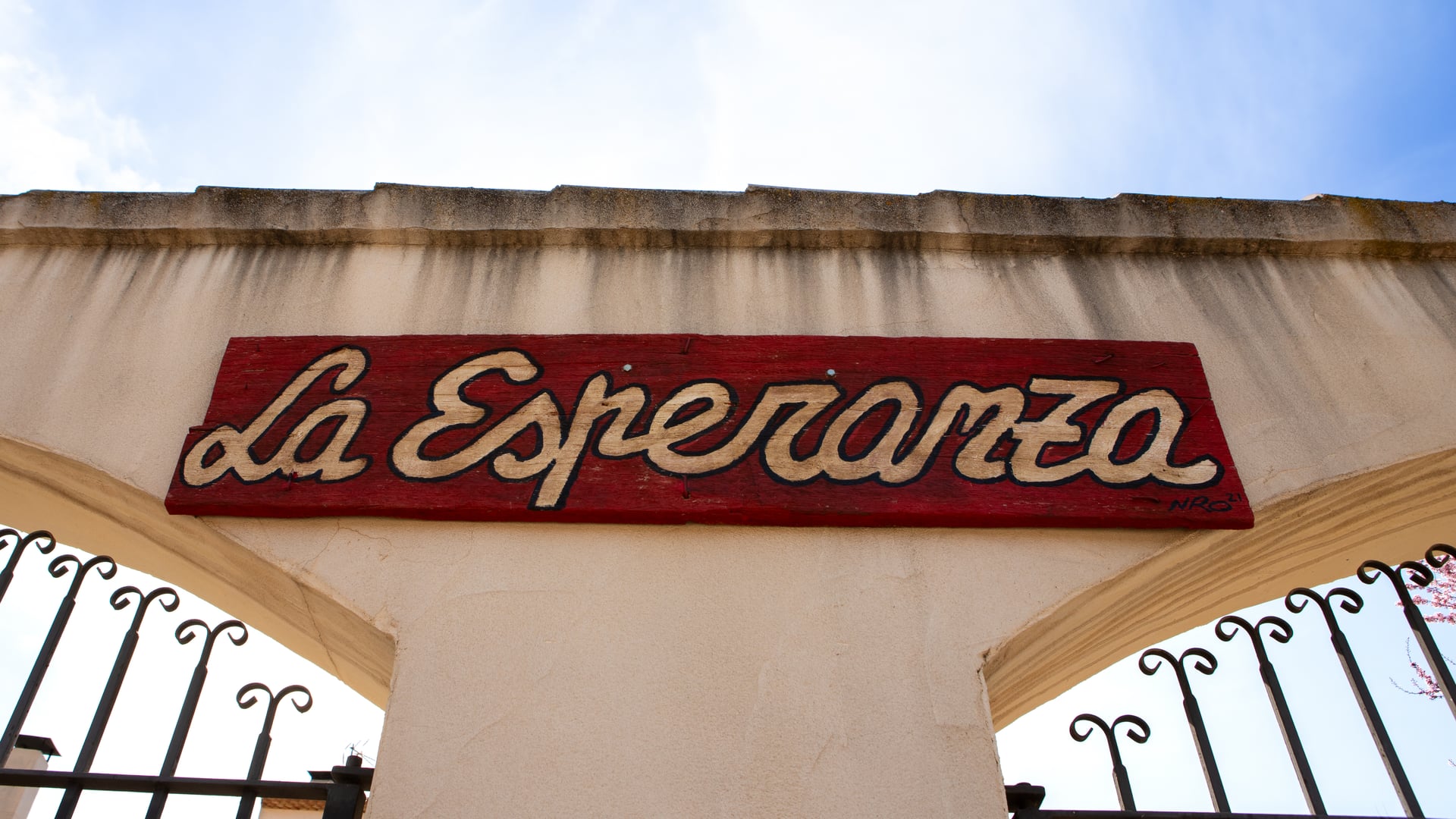
To eat at Finca La Esperanza is to do so surrounded by the very olive trees that give meaning to everything above. From the terrace with stone arches, the view is lost among centuries-old trees and the silhouette of the Sierra del Maigmó in the background. It is a setting that turns any meal into an experience linked to the landscape, the season and tradition.
Here, oil is not an anonymous supermarket product: it is the reflection of the land seen from the table. Every dish of our Mediterranean cuisine pays quiet homage to those olive trees that have been bearing fruit in the Vinalopó for centuries. And that bond between landscape, oil and cooking is what makes the experience different.
If you want to experience olive culture up close and taste a cuisine that respects it, we await you at the finca. Remember that we work by prior reservation only, Wednesday to Sunday from 1:30 pm to 6:30 pm. Book your table by calling 650 45 01 09 or check how to get here on our contact page. Come and eat among the olive trees: the tradition of the Vinalopó awaits you with the table set.